

Last Updated: November 2, 2026
Quick Summary
Dollar store crochet hooks are fine for learning, but a better hook tends to pay off in smoother glide, comfort and even stitches. Finish and handle shape matter more than price, so test a hook in your hand before buying. Start by upgrading the size you use most often.
- Price is a poor guide to quality; finish, material and handle shape matter more.
- A burr or ridge at the throat splits yarn, and that is a finish fault you cannot fix by technique.
- Aluminum with a smooth finish is a strong all-round choice for fine yarn and long sessions.
- Hand fatigue often comes from the handle, so try a cushioned, ergonomic grip.
- Upgrade the one or two sizes you use most before buying a full set.
Table of Contents
- How Dollar Store Crochet Hooks Compare to Better Tools
- Crochet Hook Materials Compared: Aluminum, Plastic and Steel
- Ergonomic Crochet Hooks and Hand Fatigue
- Crochet Hook Size Guide: Matching Hooks to Your Yarn
- Choosing Your First Upgraded Hook at JOERIAKNITS
- Frequently Asked Questions
How Dollar Store Crochet Hooks Compare to Better Tools
Dollar store crochet hooks are a fine place to start. Many crocheters learn the basics on a cheap hook and never think about it again. The question is when that cheap hook stops serving the work you are doing.
The honest answer is that price is a poor guide to quality on its own. Finish, material and handle shape tend to matter more than the price tag. For hands-on feedback on how specific hooks perform, see our crochet hook reviews.
Where a better hook tends to pay off is in consistency. A well-finished aluminum or quality-coated hook glides through yarn with less drag, which helps your stitches stay even across a long project. That matters most in larger works, where a small amount of friction repeated thousands of times adds up to sore hands and uneven fabric.
If you want to compare your current hooks against something better, the Clover Amour Crochet Hooks are a useful benchmark. They use a smooth aluminum shaft and a comfortable elastomer rubber handle, and their vibrant colours make sizes easy to identify. For a softer, more budget-conscious step up, the Clover Soft Touch Crochet Hooks offer a light, well-balanced handle.
Crochet Hook Materials Compared: Aluminum, Plastic and Steel
Material is the single biggest factor in how a hook feels, but material alone does not explain why one hook glides and another snags. The working end of a hook has four parts that matter: the head (the rounded tip that enters the stitch), the throat (the cut-away groove that catches the yarn), the shaft (the straight section that sets stitch size), and the handle. Two hooks made of the same aluminum can behave completely differently if the head is blunt, the throat is roughly cut, or the shaft is not polished.
Aluminum is a common choice for quality hooks. It is light, rigid and, when properly finished, very smooth. A well-polished aluminum head tapers gradually, so it slides between the legs of a stitch rather than forcing them apart, and a smooth throat lets the yarn feed without catching. Its main weakness is that a poorly polished aluminum hook can have a faint ridge at the throat or a burr on the head, which snags fibers and splits the yarn, the split you see is usually a finish problem, not a metal problem.
Plastic hooks are inexpensive and comfortable for some people, but they flex more under pressure. That flex changes how the shaft behaves: a shaft that bends slightly under tension can vary the size of your loops, which shows up as uneven stitch height across a row. Quality can vary widely between plastic products, so check the finish and feel before buying. A glossy, rigid plastic hook with a cleanly moulded throat can work well; a matte hook with a visible seam line down the shaft will catch yarn on every stitch.
Steel hooks are fine and strong, which suits very delicate thread work. The small head and narrow throat are designed for cotton thread rather than yarn, so they are a specialist tool rather than an everyday one. They are heavier for their size and can be less comfortable over long sessions.
A simple rule: if you crochet with fine yarn or work for long stretches, an aluminum hook with a smooth finish is usually the best all-round choice. If you only crochet occasionally with bulky yarn, a plastic hook may be perfectly adequate. When you inspect any hook, run a fingertip along the throat and the inside of the head, any roughness you can feel will catch yarn.
Ergonomic Crochet Hooks and Hand Fatigue
If your hand aches after half an hour, the hook may be the problem rather than your technique. Hand fatigue is one of the most common reasons experienced crocheters look for an upgrade, and it is the area where ergonomic design makes the clearest difference.
Clover Amour Crochet Hooks - Small-Medium Sizes →
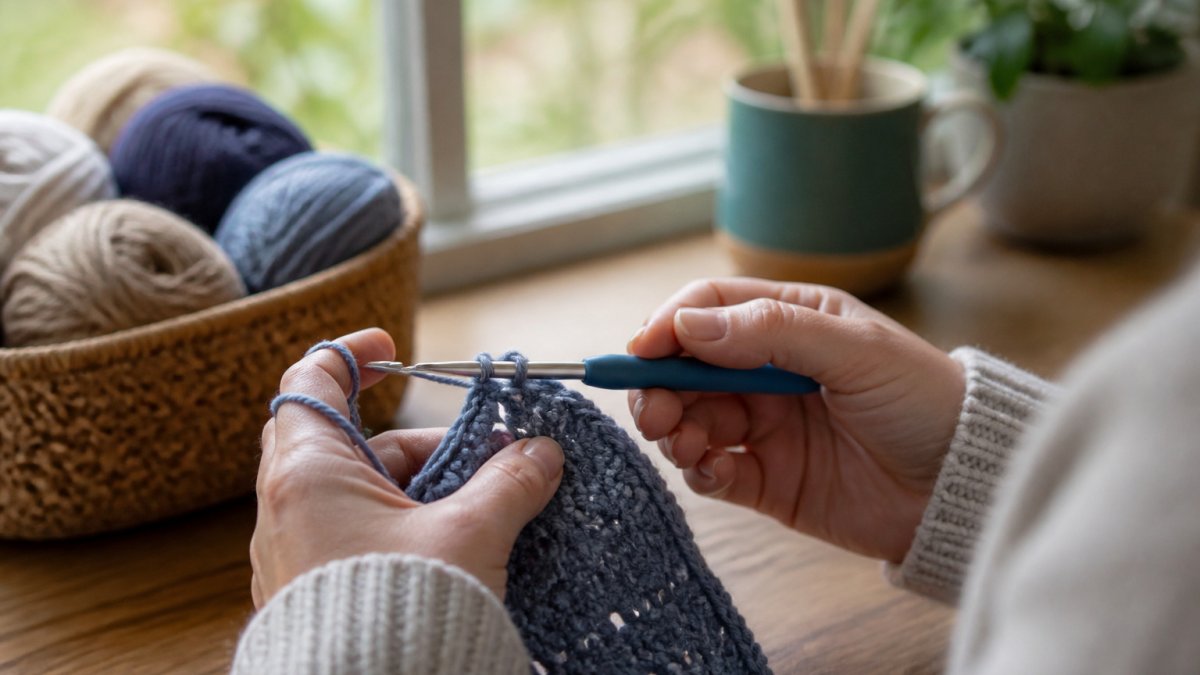 Illustrating how cushioned grips reduce hand strain during crochet projects
Ergonomic hooks use shaped or cushioned handles designed for comfortable grip. The Clover Soft Touch Crochet Hooks feature soft-touch grips and a light, well-balanced handle.
The Addi Comfort Grip Crochet Hooks Each hook is thoughtfully designed with an easy grip handle that is color-coded according to size, allowing you to quickly identify the right hook for your project. The smooth metal tips glide easily through yarn, reducing snagging and making your crochet work more enjoyable. If you're looking to enhance your crochet experience, these hooks are a fantastic addition to your toolkit.

A practical test: try a few hooks in your own hand before you buy. The right grip should feel secure without squeezing, and the handle should let your wrist move freely.
Crochet Hook Size Guide: Matching Hooks to Your Yarn
Choosing the right size matters more than most beginners expect. A hook that is too small creates tight, stiff fabric. One that is too large produces loose, gappy stitches. The size is usually printed on the pattern, and it is measured in millimeters in most of Canada, with US letter and number sizes used in some older patterns. A 5.0 mm hook is the same tool whether a pattern calls it H-8 or 5.0 mm, so convert before you shop.
Use the yarn label as your starting point. Fine yarns generally call for smaller hooks, while bulky yarns need larger ones. Always crochet a small swatch before starting a project, and adjust the hook size until the fabric matches the gauge in your pattern. The swatch is also a useful diagnostic: if the same yarn and the same nominal size produce a stiff, squeaky fabric on one hook and a smooth, even one on another, the difference is the hook's finish and throat, not your tension.
Size is where the upgrade decision gets practical. Most crocheters use a narrow band of sizes, commonly somewhere between 3.5 mm and 6.0 mm for worsted and DK yarns, and reach for one or two of those far more than the rest. That is why upgrading the single size you use most often is usually the best value: you get the smoothness and comfort where your hand spends the most time, without paying for sizes you rarely touch. Add the next size up or down only when a project actually calls for it.
A set makes sense when you work across many yarn weights, because buying individual hooks one at a time costs more in total. The KnitPro Oasis Interchangeable Crochet Hook Set, is ideal for beginners and seasoned crocheters. Catering to the needs of every crocheter, the sets feature versatile metal interchangeable crochet hooks in the shade of rose gold snugly fit on the grey onyx or rose wooden handle. The Oasis Crochet Hook Set is thoughtfully designed to accompany a wide range of crochet projects. The set includes seven hook sizes from 2.0 to 5.0 mm, along with a set of accessories.
The Waves 2.0 Deluxe Crochet Hook Set, has an ergonomic design of rubber handles that comfortably fits in the hands, and the colour-coded handles are individually held in place in a zipped case for easy identification and organization. The Waves 2.0 Deluxe set has popular hook sizes that work for a wide range of projects, making them ideal for both beginners, who are just starting their crochet journey, and experienced crafters, who are looking for high-quality tools. The deluxe set covers nine sizes from 2.0 to 6.0 mm.
Watch out: a large set is poor value if half its sizes never leave the case, so check the size range against the yarn weights you actually use before buying.
Choosing Your First Upgraded Hook at JOERIAKNITS
You do not need to replace your entire collection at once. A sensible path is to upgrade the hook you use most, then add sizes as your projects demand them.
If your budget is tight, start with a single comfortable hook in the size you reach for most often. The Clover Soft Touch is an accessible first step. If you prefer aluminum and want a smooth glide, the Clover Amour Crochet Hooks are a strong choice, with sizes 6.5 mm and up sold separately as Large Chunky Sizes.
If you crochet across many sizes, a full set is more economical than individual hooks. But a common mistake is buying a large set before you know which sizes you use. Start with what your current projects need, then build out from there.
Frequently Asked Questions:
Are dollar store hooks worth it?
They can be, for simple projects and short practice sessions. Budget metal and plastic hooks are often smooth enough to learn basic stitches, and the cost is low if you decide crochet is not for you. Problems tend to appear with heavier yarns, long sessions or intricate work, where a rough surface can snag fibers and tire your grip. If you notice splitting yarn or a hook that catches, that is a sign to try a smoother aluminum hook such as the Clover Amour Crochet Hooks.
Do ergonomic crochet hooks reduce hand fatigue?
A well-shaped, cushioned handle is designed for comfortable grip during longer sessions. The Clover Soft Touch Crochet Hooks, have a light, well-balanced handle with a soft grip designed for extended work. Ergonomic design will not fix poor tension or an incorrect hook size, so check those first before attributing fatigue to the tool.
Are metal or plastic crochet hooks better?
Metal hooks, particularly aluminum, are often smooth through yarn when properly finished. Plastic hooks are lighter but can flex under pressure. For most upgrade decisions, a smooth aluminum shaft is the first change to consider, and the Addi Comfort Grip Crochet Hooks, offer smooth metal tips with an easy grip handle.
How do I choose the right crochet hook size?
The hook size should suit the yarn weight and the stitch pattern in your pattern, and the size is usually printed on the pattern or the yarn label. Sizes are given in millimeters and, in some sets, in US letter and number equivalents, so check which system your pattern uses. A starter set such as the KnitPro Wave 2.0 Deluxe Crochet Hook Set has 9 hooks with soft elastomer handles, covering sizes 2.0 to 6.0 mm, which suits most beginner projects.
