

Last Updated: October 28, 2026
Quick Summary
The essential knitting tools for beginners are a smooth set of mid-range needles, stitch markers, a row counter, a gauge tool, compact scissors and a darning needle. Together they let you finish a first project without frustration, and none of them needs to be expensive.
- Choose one reliable knitting needle set covering several mid-range sizes, such as 3.0 mm to 5.0 mm.
- Use stitch markers to flag pattern repeats, increases and the start of each round.
- A gauge tool confirms your knitting matches the size the pattern expects, saving wasted yarn.
- Interchangeable sets are ideal especially if your gauge is off and you need to change the needle size.
- Add storage and repair items such as repair hooks once you rely on the basics.
Table of Contents
- Why the Right Tools Matter for Your First Projects
- Choosing Your First Beginner Knitting Needles
- Understanding Knitting Needle Sizes
- Stitch Markers, Row Counters and Gauge Tools
- Knitting Notions for Beginners: Scissors, Needles and Stitch Holders
- Storage and Repair Accessories Worth Having Early
- A Practical Knitting Tools Checklist
- Types of Beginner Projects to Try With Your Tools
- Choosing Your First Kit and Booking Your Starter Supplies
- Frequently Asked Questions
Why the Right Tools Matter for Your First Projects
Essential knitting tools for beginners are the handful of needles, notions and accessories that let you finish a first project without frustration. The right kit does not need to be expensive, but it does need to be deliberate.
Most beginners underestimate how much small tools affect the experience. A pair of smooth, well-sized needles keeps stitches even. A row counter stops you from losing your place mid-scarf. A stitch marker shows where a pattern repeat begins. None of these items is glamorous, yet each one removes a point of friction that would otherwise make you want to put the work down.
Choose one reliable set of knitting needles, a gauge tool, a way to mark stitches, and a pair of compact scissors. Add storage and repair items once you have begun to rely on them. The sections below walk through each category, explain why it matters for a beginner, and end with a checklist you can use when you shop.
Choosing Your First Beginner Knitting Needles
Beginner knitting needles are the single most important purchase in your kit, because they touch every stitch you make. A beginner needle should be smooth enough that yarn glides rather than catches, sized so your stitches are not forced, and long enough to hold your project comfortably. Aluminum and nickel-plated needles tend to suit new knitters well, since their tips are sharp enough to pick up stitches cleanly.
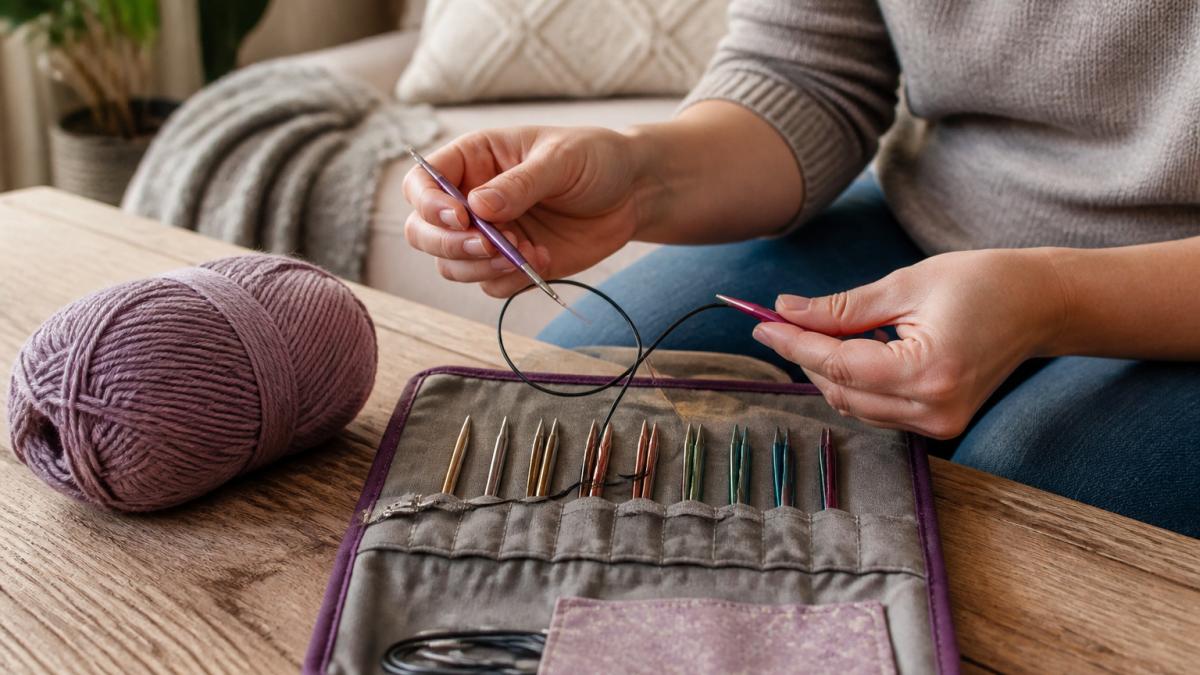
The KnitPro Zing Starter Interchangeable Circular Needle Sets includes five pairs of interchangeable tips in popular sizes, along with swivel cables and a zippered case, so you can test several needle sizes without buying a separate needle for each. The lightweight aluminum construction and colour-coded tips make sizes easy to identify, which matters when you are still learning to read your needles at a glance.
Interchangeable sets do have a learning curve. Cables must be fully attached before you start, and it is easy to lose a cable key or end cap if you do not keep them in the case. Best for: knitters who want flexibility across several projects. Skip if: you only plan to make a single flat scarf and want the lowest possible starting cost.
Circular versus straight needles
Straight needles are the traditional option and suit flat pieces such as scarves, dishcloths and simple squares. They are inexpensive, easy to handle and a good way to learn basic stitches. However, they have a fixed length, so large projects can become awkward to manage.
Circular needles are two needles joined by a flexible cable. They suit both flat and round work, and they hold large numbers of stitches comfortably. Many beginners find circular needles more comfortable over time because the weight is spread across the cable instead of two rigid sticks. For more information read the Twisted Loops Blog Circular vs Straight Needles Making the Right Choice.
The beginner's kit main pieces, with the note the article gives for each.
| Item | Note |
|---|---|
| KnitPro Zing Starter Interchangeable Set | Five pairs of tips, swivel cables, zippered case |
| Spiral Stitch Markers (pack of 30) | Own case, easily slips onto needle or fabric |
| Clover Mini Row Counter | Counts 0 to 99, locks, wearable on a cord |
| Clover Swatch Ruler and Needle Gauge | Needle gauge, crochet hook gauge, 10 cm ruler |
| Compact Scissors with Blade Cover | Measures 10 cm, snap-on cover |
| Curved Tapestry Needles | Set of four, aluminum, reusable case |
| Clover Double Ended Stitch Holder | Two lengths, works from either end |
| KnitPro Repair Hooks (set of three) | Hook and needle ends, birch wood |
Understanding Knitting Needle Sizes
Knitting needle size refers to the diameter of the needle, and it directly controls how large your stitches are. Thicker needles produce looser, larger stitches, while thinner needles produce tighter, smaller ones. Sizes are written in millimeters in most of the world, and older patterns often use US or UK numbering, so it helps to keep a conversion reference nearby.
For a beginner, the most useful sizes usually fall in the mid-range. A set covering 3.0 mm to 5.0 mm, like the sizes included in the KnitPro Zing starter set, gives you enough variety to try different yarn weights without overwhelming you. Thin yarns generally call for smaller needles, while bulky yarns call for larger ones. Always check the yarn label and your pattern before choosing.
Needle length matters too.
Be aware that needle size and gauge are linked. Two knitters using the same size needle can produce different stitch counts, which is why gauge measurement matters (covered in the next section). Treat the needle size on a pattern as a starting point, not a guarantee.
Stitch Markers, Row Counters and Gauge Tools
These three small tools solve problems that every beginner runs into. Stitch markers flag pattern repeats, increases and the beginning of a round. A row counter keeps track of how many rows you have completed. A gauge tool confirms that your knitting matches the size the pattern expects.
Unlike open ring markers that can slip off mid-row, the spiral stitch markers click securely in place and stay put through every row, every stitch count, and every pattern repeat. No more losing your place in a complex cable or colour work section.
The Clover Row Counter counts from 0 to 99, locks to prevent accidental advances and can be worn around the neck on a cord.
For gauge, the Clover Swatch Ruler and Needle Gauge combines three functions. It has a needle gauge that identifies needle sizes across US, metric and Japanese standards, a crochet hook gauge and a 10 cm swatch ruler for counting stitches and rows. Measuring a gauge swatch before you start a garment can save a great deal of wasted yarn, so this is one of the more valuable items on the list.
KnitPro Zing Starter Interchangeable Circular Needle Sets →
Knitting Notions for Beginners: Scissors, Needles and Stitch Holders
Notions are the supporting tools that make knitting practical. Scissors cut yarn cleanly, darning needles weave in ends, stitch holders keep work safe, measuring tapes confirm sizing and repair hooks rescue dropped stitches.
Compact scissors are one notion to consider. The Compact Scissors with Blade Cover measure 10 cm and come with a snap-on cover, so they fit easily into a project bag. Choose the curved or straight blade depending on what feels comfortable.
Darning needles are used to weave in yarn tails once a project is finished. Unlike straight tapestry needles, these curved tapestry needles feature a gently curved tip that makes it significantly easier to hook through stitches and weave in ends — even in tight or loosely knitted fabric. Less fumbling, faster finishing.
The Clover Double Ended Stitch Holder lets you slip stitches on from either end, and it comes in two lengths.
The HiyaHiya Alpaca Retractable Tape Measure extends to 150 cm.
Repair hooks are the last essential notion. The KnitPro Repair Hooks, a set of three sizes, are made from laminated birch wood and have a hook on one end and a needle on the other. They are perfect for picking up dropped and fallen stitches.
Storage and Repair Accessories Worth Having Early
To keep your tools all in one place, JoeriaKnits handcrafted notion organizer is the perfect addition. They are a soft compact case with a snap closure and easily fit into any project bag.
A Practical Knitting Tools Checklist
Use this checklist when you assemble your first kit. Tick off items as you buy them, and add the optional extras once the basics feel comfortable.
- Beginner needles: one interchangeable or circular set covering several mid-range sizes
- Straight needles for simple flat pieces (optional if you own circulars)
- Stitch markers in at least two colours or sizes
- Row counter that locks and resets to zero
- Gauge tool with a needle gauge and a swatch ruler
- Compact scissors with a blade cover
- Blunt tapestry needles for weaving in ends
- Stitch holder for pausing live stitches
- Tape measure for checking finished sizes
- Repair hooks for dropped stitches
- Storage pouch or clutch for needles and notions
Types of Beginner Projects to Try With Your Tools
As your confidence grows, a flat jumper panel or a basic shawl can use the stitch holder and tape measure. Always measure a gauge swatch before starting anything large, since sizing mistakes are costly on bigger pieces.
Choosing Your First Kit and Booking Your Starter Supplies
We also recommend reading Knitting Essentials Every Beginner Needs to Get Started before your first project, since it offer additional information that complement this article. Starting with the right tools makes the first project far more enjoyable, and the rest of the craft follows from there.

Frequently Asked Questions
What tools do you need to start knitting?
A beginner mainly needs a set of needles, some yarn and a handful of small accessories, including stitch markers, a row counter, a gauge tool, scissors, a darning needle, a stitch holder, a tape measure and repair hooks for dropped stitches.
What size knitting needles should a beginner use?
Most beginners do best with mid-range needle sizes, since they are easier to control than very fine or very large needles. The KnitPro Zing Starter sets, for example, include five pairs of tips in sizes 3.00, 3.50, 4.0, 4.5 and 5.0 mm, which covers the range most beginner patterns call for.
Are straight or circular knitting needles better for beginners?
Circular needles generally work better for beginners, since one set can cover several needle sizes and handles both flat and round knitting, and stitches are less likely to slide off the ends. Straight needles are still fine for simple flat pieces, but they are optional once you own a circular set. The KnitPro Zing Starter Interchangeable Circular Needle Sets are an example of this kind of set.
Do beginners need stitch markers for knitting?
Yes. Stitch markers help you track pattern repeats, increases, decreases and the start of a round, which makes them useful from your very first project. The Spiral Stitch Markers glides effortlessly onto your needle without catching or snagging yarn — even on delicate fibers. Removing and repositioning is just as easy, so you can focus on your knitting rather than wrestling with your tools.
What is the difference between a tapestry needle and a regular sewing needle?
A tapestry needle has a blunt tip and a larger eye, so it passes through yarn without splitting it, which is what you want when weaving in ends. A regular sewing needle has a sharp point made for piercing fabric, so it is not suited to knitted stitches. Our high-quality aluminum tapestry needles are sturdy, wear-resistant, and built to last. They won’t bend or break with regular use, making them a reliable addition to any knitting or crochet toolkit.
How do you choose knitting needles for a first project?
Choosing needles for a first project mainly comes down to matching the needle size to your yarn and pattern gauge, and picking a material that feels comfortable to hold. The KnitPro Zing Starter sets, for example, have lightweight aluminum tips with a smooth surface and are available in two length options.
What knitting tools are useful but not essential for beginners?
A few tools make knitting easier without being strictly necessary for a first project: a needle and swatch gauge for checking sizes, a stitch holder for pausing live stitches, and repair hooks for fixing dropped stitches. The Clover Swatch Ruler and Needle Gauge includes a knitting needle gauge, crochet hook gauge and swatch ruler. The Clover Double Ended Stitch Holder lets stitches be moved from either end of the holder and kept secure when not in use. The KnitPro Repair Hooks set includes three sizes of birch wood repair hooks for fixing dropped and fallen stitches.
Which knitting tools should I buy first on a small budget?
On a small budget, start with the lowest-cost basics you will use on every project, such as a pair of scissors for cutting yarn. The Compact Scissors with Blade Cover measure 10 cm and have a snap-on cover.
